
Published by Dating in Your 30s
Collect recent photos before judging individual shots
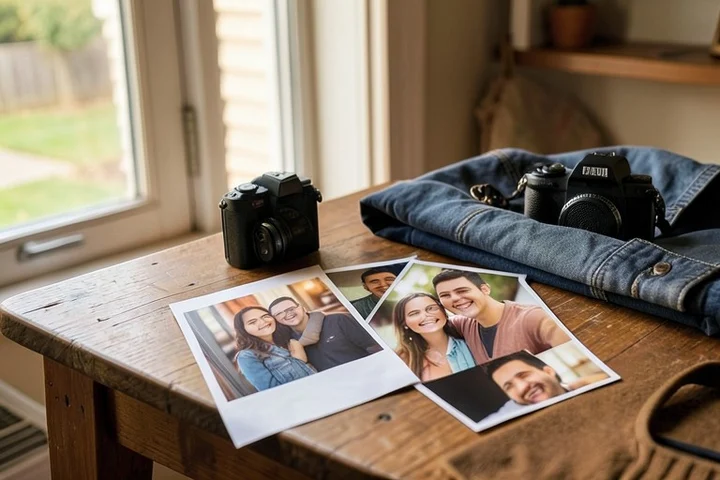
- Gather a broad group of recent candidates, including portraits, full-length images, everyday settings, interest-based activities, and social occasions.
- Remove images that no longer represent current hair, clothing, facial hair, body changes, or other visible features.
- Mark repeated poses, outfits, backgrounds, and activities so the final set communicates variety.
- Keep several workable options for each role before selecting the lead photo or final order.
Lead with a clear and recognizable current portrait
- Point: Visible facial features Detail: The first image should show the face clearly, with enough light and focus to make identity straightforward.
- Point: Current appearance Detail: Select a portrait that matches how you look now. Older images create uncertainty when the rest of the profile shows a different appearance.
- Point: Natural expression Detail: A relaxed, genuine expression communicates more clearly than an exaggerated pose or heavily staged reaction.
- Point: Unambiguous identity Detail: Avoid sunglasses, heavy shadows, distant framing, masks, large props, or another person sharing the main visual focus.
Add context without repeating the same image
- Place a sharp full-length image after the lead portrait to show clothing, general presentation, and how the person appears beyond a close crop.
- Add contextual images from ordinary settings or genuine interests, such as cooking, walking, making music, attending an event, or spending time outdoors.
- Choose photos with different distances, compositions, outfits, and settings so each image supplies new information.
- Limit near-duplicates, including several selfies with the same expression, multiple vacation views, or repeated formal outfits.
Use group photos only when identity remains obvious
A group photo belongs later in the profile, after individual images have established identity. It can show social context, but it should not require viewers to determine which person owns the profile. The profile owner should remain easy to identify through position, framing, or visual prominence.
Keep group shots limited and avoid images where faces are tiny, partly hidden, heavily cropped, or surrounded by several equally prominent people. Children, coworkers, or friends also introduce privacy considerations, so images with identifiable others need appropriate permission and a clear reason for inclusion.
Keep image quality high and editing believable
Use photos that are in focus, adequately lit, and cropped so the face and body are not accidentally cut off. Blurry images, dark interiors, extreme backlighting, screenshots, and low-resolution crops obscure the details a profile photo needs to communicate. A simple composition usually works better than a cluttered background.
Editing should correct ordinary problems such as exposure or a distracting crop without changing recognizable features. Heavy filters, face-smoothing, altered proportions, artificial backgrounds, and retouching that removes normal texture can make the image inaccurate. The same standard applies to every photo so the set presents one consistent, current appearance.
Checking the set for accuracy, sequence, and privacy
- Lead clarity: The first image shows a current face clearly, with no group shot, sunglasses, heavy filter, or distracting obstruction.
- Recent appearance: The photos represent present-day hair, clothing, facial features, and overall presentation.
- Sequence: The lead portrait comes first, followed by full-length, contextual, interest-based, and selective social images.
- Visual variety: Each photo changes the setting, composition, activity, or information instead of repeating the same pose.
- Identity clarity: No image makes viewers identify the profile owner among several equally prominent people.
- Privacy: Backgrounds, badges, home details, vehicle information, documents, and location clues do not disclose more than intended.
- Completion check: Every retained image adds useful information and remains accurate without misleading editing.